
Trail Braking
The Atlantic Moto Skills “Beginner Riders Course” covers the basics of riding curves. Our classroom and group discussions avoid advanced technical details and cater to the absolute beginner, as the course name suggests. For simplification, we use a “Slow → Look → Press → Roll” process of cornering:
- Slow down to the curve’s required speed
- Look for both the apex and the planned exit of the curve
- Press on the bar in the direction of the turn to begin the Counter-Steering process
- Roll on the throttle as you pass the apex to steer your motorcycle to the planned exit.
We also use a simplified approach to emergency braking in a curve which sees us fully square the motorcycle up to it’s upright position, before front brakes are applied. At the beginner level we provide repetitive practice following these steps:
- Identify the hazard
- Use proper Eye Control by picking a spot straight ahead, which then steers the motorcycle to that spot
- Begin the Straight-Line Braking Process – after the motorcycle is upright.
This is a good exercise, but it leaves a lot of traction on the table.
My M2 instructor, many moons ago, laid it out simply with her “Dollar’s Worth of Traction” lecture. I’m paraphrasing, but she stated:
“Your motorcycle’s tires have $1.00 worth of traction. In the case of the front tire, traction is required for both stopping and cornering. A tight corner could use $0.50 worth of traction, leaving only $0.50 worth of traction remaining for braking.”
For the beginner this is great. AMS’s “Slow → Look → Press → Roll” addresses this and never has you brake while initiating the turn. This is sound advice for the beginner rider. In fact, in our opinion, Eye Control is the first cornering technique a beginner should perfect.
However, even after a few months of riding you likely have the eye control, coordination, and skill to go down the rabbit hole of motorcycle trail-braking — giving you another tool in the toolbox of motorcycle safety.
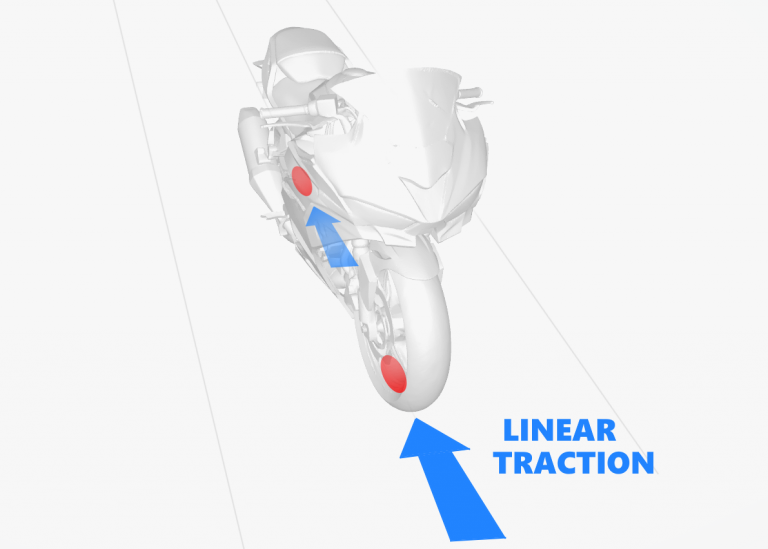
Linear Traction (Braking)
The round cross-sectional shape of our tires plays a part in turning the motorcycle when it is leaned into a turn. However, this shape provides a minimal contact patch between rubber and asphalt compared with a typical (non–counter-steering) car tire. This helps explain why motorcycle tires “square off” and might only have a lifespan of about 12,000 km, versus a typical car tire which can last 60,000 km.
If you draw the shape of this contact patch on paper, it would be an oval for both front and rear tires. (Red Ovals in the pictures below) This shape changes. In the case of the front tire, when more force presses down on the contact patch during braking as a result of weight shifting forward, the contact patch grows in size and delivers more traction. This is yet another reason a motorcyclists needs be hypervigilant with tire pressure. During our “Straight-Line Braking” exercise in the Beginner Riding Course, we teach you never to use 100% of the front brake’s power before this weight transfer to the front wheel is observed. We suggest a 30% → 60% → 90% approach on the way to full power. We are only talking about braking here in this dicussion, but the same reasoning applies to the rear tire as we accelerate: As we accelerate, the rear tire gains significantly more contact patch as a result of the weight shifting rearward, resulting in more rear wheel linear traction.
Lateral Traction (Cornering)
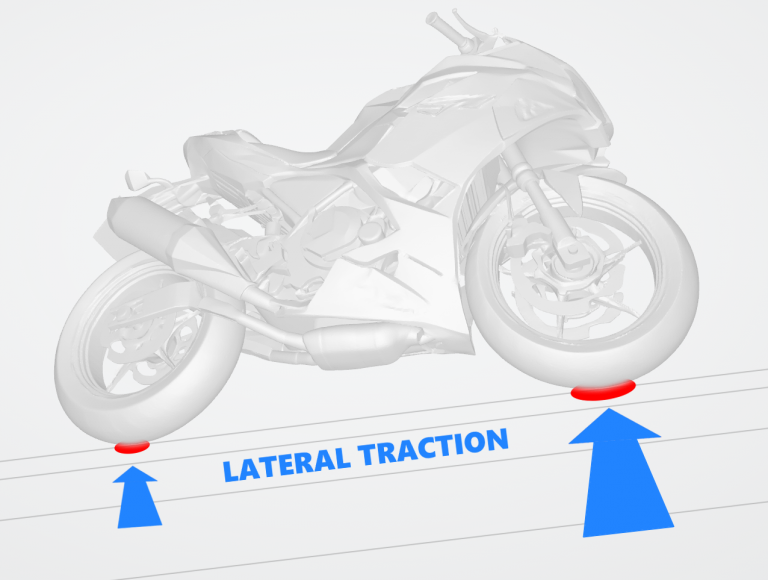
As we know, motorcycles turn by leaning. Our counter-steering discussion covers this in detail. Regarding traction, the level of lean dictates how much lateral traction is required. When a motorcycle is at the apex of a turn it generally requires the most lateral traction. When it is traveling in a straight line the motorcycle needs hardly any lateral traction at all — just enough to keep the front wheel rolling straight.
Linear Vs. Lateral Traction (Cornering Vs. Braking)
If you have gotten this far in our discussion, you have probably already tied linear and lateral traction together and have at least a novice grasp of the basic concept of trail braking, which is the goal of this dicussion. The term “trail braking” simply refers to trailing off the brakes as lean angle is introduced. Practice with this enables the use full use of our available front wheel Linear Traction based on how much Lateral Traction is needed for the curve. At a moment where your leaning your machine at only, say 10 degrees, you might have 95% available traction for braking. At the apex of the curve where your machine is nearing it’s maximum lean angle, you might have only 10% available traction for braking. This is a great skill to practice and provides the rider far more opportunity to use that important and powerful front brake, than a newbie practicing the “Slow → Look → Press → Roll.” Of course, this requires practice.
For the last decade or so, motorcycle manufacturers have expanded ABS systems. Many high-end bikes now come with “Cornering ABS” that follow the trail-braking concept. Lean and pitch sensors measure your level of lean and pitch, then adjust ABS initiation. Without going into a significant amount of detail, these ABS systems are less sensitive when upright but become ultra-sensitive when the bike is fully leaned over. On some machines, these same lean/pitch sensors tie into traction-control systems to limit power when the bike is leaned over, better controlling rear-wheel traction. Google “6-axis IMU” if you want further detail on these systems we now see on motorcycle showroom floors.
PHd
Now for the PhD in motorcycle safety that we are all on the quest for. Let’s return to my old M2 instructor and a part of her lecture:
“Your motorcycle’s tires have $1.00 worth of traction.”
I have fond memories of that instructor. Being an instructor myself, I have a soft spot for passionate motorcyclists who give up their weekends to teach a sport they obviously love. But she left a tiny bit on the table by omitting one concept — perhaps because I was a newbie and focused on other basic skills. We mentioned that the contact patch grows during weight transfer while braking. Some of this increased traction from braking can also be used for cornering (lateral traction). So, technically, during braking and turn-in toward the apex you could assert that you have about $1.50 of traction, where $0.75 could be used for cornering and $0.75 for braking, as opposed to $0.50 and $0.50. Nice! This gives us a small glimpse of how technical motorcycle racing can be. In my opinion, MotoGP riders are at the pinnacle of riding ability and could be considered traction gods. Every single detail is addressed and perfected — especially considering how a tire’s performance and how well a racer protects that performance throughout the race can decide the winner.
Most of us are not racers, nor would we want to be. But if you have racetrack aspirations, we would always suggest starting with a track school. In our neck of the woods, it is my understanding that the Atlantic Roadracing League has classes for the beginner, intermediate and advanced, where you can perfect braking and cornering skills on a controlled racetrack.
For the rest of us, having the knowledge and skill of trail braking will make us better and safer riders. Get out there and experiment with the subtle easing off of that front brake as you fall into a turn. This will inevitably provide us the comfort level to perform this skill when it is called upon in emergency situations. Like everything that has to do with motorcycle control, think “baby steps” and work up to this. Practice makes Permanent.
