
Frequently Asked Questions
Do I need to have the written test completed before taking your course?
No, you don’t. In years past, Service New Brunswick (SNB) has asked for the blue certificate (that you will be earning after completing our course) before allowing you to take the written test. It is our understanding that they have relaxed this rule after offering the written test on-line. Many of our students have completed the on-line version of this test before attending our course. The written test is said to be good for 6 months, so keep that in mind. If you are planning on completeting the on-line test before taking our course, please visit our “Study Area” above. We can help you study for it.
How do I book a course?
The red button below will take you to our “Book a Course” Section on this website. This online portal will secure your spot in one of our 3 courses. Our “Beginner Course” is the course you would select to get your 2 Wheeled motorcycle license in New Brunswick. You will also see a section for our “Mid-Week Beginners Course” and our “Learn to Ride Three Wheels” course. A credit card will be required to register. It is possible to pay with cash in person. Please call us at 506-268-2000 if this is required. As a general rule, we require the full cash payment up front. However for some extreme cases, we can take a partial payment. Again, call us at 506-268-2000 if this is something that you need us to set up.
Do you have any further info on the Special MID-Week riders course?
We have been asked countless times to cater to the shift workers who often work weekends. Enter our “Mid-Week Course.” We will be limiting this course to 10 seats and 2 instructors. Tuesday night (6pm) will be the classroom session, and Wednesday and Thursday (8am) will be the practical sessions. This course and it’s availability can be found in our “Book a Course” section of our website. Keep in mind, our driving range is available “Mid-Week” only for the months of July and August due to NBCC’s fulltime student schedule.
Where do we meet on Friday Night, Saturday and Sunday?
At 5:45-ish pm Friday night, enter the (front) main doors at NBCC, 1234 Mountain Road Moncton, and we will guide you to the classroom. Both the “Beginner Motorcycle Course” and the “3 Wheel Motorcycle Course” will have the Friday night session within NBCC. Keep in mind you don’t need any riding gear for the classroom portion. At 8:00am on both Saturday and Sunday we are around the back of the building. We have it mapped in our “Contact Us” page below.
How long is the Beginner Motorcycle Course?
We start with the 3 hour classroom portion on Friday night. Then we have two full days on Saturday and Sunday. The course is 20 hours in total. Unless we are behind schedule, we typically give you one hour at lunch on Saturday and Sunday. If you have selected the “Mid-Week” Course, the 3 hour classroom session would be Tuesday night, and the practical sessions would be all day Wednesday and Thursday.
What is your cancellation policy?
We get it. Sometimes life gets in the way. Keep in mind, we are mandated by the province to provide a 5:1 student to instructor ratio for all of our courses. Instructors are booked based on the number of riders attending. As a result, we refund all but a $100 cancellation fee in the event you wish to cancel our course with more than 7 days notice. If you have given us less than 7 days notice that you wish to cancel, there will be no refund unless your seat on the course is filled by another rider. There is often a waiting list for our courses, so this scenario is unlikely.
The remaining payment, less the $100, will be transferred back to you within 30 days of your notification to cancel. If you have completed one or more or our 5 sessions, but cannot complete our course, please call us at 506-268-2000 and we can discuss our options.
How hard is it to pass the Beginner Motorcycle Course?
Not hard at all. We have had fantastic success with this course and we are very pleased with our pass rate and the quality of our students we have graduated. We have designed the exercises to keep students moving. One of the reasons for our success has been the seat time we have been able to our offer our students. We have recorded 50-60km of riding. This is a substantial amount of riding considering that we simply ride in a parking lot. Keep in mind, while many feel this course is not difficult, we have a distinct level of proficiency needed from all of our students to graduate. We recognize our responsibility to produce safe riders.
There are 4 skills which we have called our “4 Essential Skills.” We will be covering these at length in both the classroom and practical portions of our course. A quick overview of these can be found in our Study Area of our website. You can find the big red button “Study Area” at the top-right of our website to bring you to this area.
What do I need to bring to the Beginner Course?
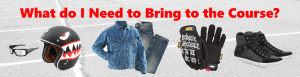
For the Friday Night Session, you don’t need to bring anything, unless you have questions about the your riding gear that you will need for Saturday and Sunday. On these remaining sessions, you need an approved helmet, boots that cover the ankle (some steel toe boots can make it difficult to shift gears), a pair of leather full fingered gloves, at least a denim jacket and pants, and eye protection. Click the button below for more detail. You would be wise to also bring sunscreen and a bottle of water. Keep an eye on the weather. We run the course even when it is raining. We supply the motorcycle.
Do I need a motorcycle license to ride a 3 Wheeled Motorcycle?
If you have a motorcycle license, you are clear to ride your 3 wheeler out on the roads. Can-Am 3 Wheelers require techniques that are as unique as the machines. Because of this, taking this course would be an advantage to the experienced motorcyclist. If you do not have a motorcycle license, you must either begin the Learner’s License process to get your 2 Wheel motorcycle license, or begin our specific Learner’s License program for 3 wheelers. Keep in mind this 3 wheel endorsement does NOT qualify you to ride a motorcycle.
How many tests are involved in getting your motorcycle license in New Brunswick?
We get this question a lot, so we have a page dedicated to explaining this process. Click the button below.
What are the restrictions of the Motorcycle Learner’s License?
In a nutshell: You cannot carry a passenger. You cannot pull a trailer behind your motorcycle. You cannot ride at night. You must have a blood-alcohol level of 0.00 at all times.
What size motorcycle can I ride with the Motorcycle Learner’s License?
The expansion letter endorsement “H” is for learner’s licence holders operating motorcycles with less than 550cc, while expansion letter endorsement “I” is for learner’s licence holders operating all motorcycles. It is our understanding that applicants are asked which motorcycle they intend to ride and are then issued the appropriate endorsement by SNB (Service New Brunswick).
After 12 months, following the successful completion of the “on-road” unrestricted motorcycle test with SNB, the type of motorcycle used during the test determines which full licence endorsement you will receive. If the test is completed using a motorcycle with less than 550cc, you will be issued the small motorcycle licence with the expansion letter “D.” If the test is completed using a motorcycle with more than 550cc, you will receive the large motorcycle licence with the expansion letter “A.”
To explain the expansion letters further, if you already hold an existing licence (for example, a Class 5 driver’s licence), you will be issued either a Class 5H or Class 5I licence when you enter the Motorcycle Learner’s Licence program.
Using the same Class 5 example, once you complete the full/unrestricted motorcycle road test, your licence will show Class 5D if you completed the test using a motorcycle with less than 550cc. If you completed the road test using a motorcycle with more than 550cc, your licence will show Class 5A, allowing you to operate all motorcycles.
How long will the Learner’s License be good for?
It is our understanding that if you have no intention of riding in conditions requiring a full license, you can hold onto the graduated license as long as you want. Keep in mind this is a risk. It is also our understanding that if you are found in violation of your restrictions, you will have to repeat the whole process over again, including both paying for, and taking another beginner riders course. There have also been issues with this graduated license when individuals have moved out of New Brunswick. Some provinces will not accept the learner’s endorsement.
Do you have any tips to share before taking my full, unrestricted motorcycle test with SNB?
Yes, we have a few. We get this question a lot as well, so we have another page dedicated to this information.
Do I need to have a car or truck license before beginning the Motorcycle Learner’s License process?
No, you don’t. The province of New Brunswick has a distinct motorcycle licence class (Class 6 and Class 6D) that covers motorcycles. Because of this, it is possible to have a Class 6 motorcycle licence without having a Class 5 endorsement.
It can get a bit confusing in New Brunswick. If you have both a Class 5 car licence and a Class 6 motorcycle licence, they omit the Class 6 and instead list the motorcycle endorsement with an expansion letter. For example, in this case your licence would read Class 5A or Class 5D, depending on the motorcycle’s engine size in cc.
The same applies to the Graduated Learner’s Licence that you will have earned after taking our course. If you already have a car licence, your licence will read Class 5I or Class 5H, again depending on which option you choose.
How old do you have to be to take the course and get my license?
You can take our course and enter into the Graduated Learner’s License in New Brunswick at 16 years of age. Applicants under 18 must have parental consent that is witnessed by a non-relative.
At AMS, this document must be signed before partaking in the practical sessions on our driving range – Saturday and Sunday for our Weekend Course and Wednesday and Thursday for our Weekday Course. A PDF version of this document will be emailed to you if you are under 18, a few days before the course. This will have to be printed off at your home, then signed for our records. We will also have this document on-hand for our Friday Night Session (or Tuesday Night for Weekday Courses), that you can take home and have signed before attending the practical sessions the next day. Whichever is easier for you.
If you will be 15 years of age at the time that you plan to take our course, please give us a call at 506-268-2000 or shoot us an email before booking for more info.
Do you offer an Advanced or Refresher Course?
Unfortunately, not at this time.
We have run our “Street Survival Course” in the past with great success, but due to insurance challenges, we will not be running this course for 2026. However, keep an eye out for a course such as this, as well as informal parking lot “Get-Togethers” to sharpen more advanced skills in the future. Our Beginner Course is just that, a beginner course. There is a WHOLE LOT more to learn and we encourage everyone to take as much training as possible. There are even on-line, self guided courses that are effective.
I just bought a motorcycle. Can I bring it to your course and use it for my training?
Unfortunately, you cannot.
Our motorcycles are carefully selected and approved by the province for use in our training program. While they are 100% street-legal motorcycles, they are registered and insured specifically as training motorcycles and are not plated for road use.
We are also quite particular when it comes to selecting the motorcycles we use for our courses. We have experience with a wide variety of machines and their ability to complete our exercises. We have gone to great lengths to select motorcycles with similar slow-speed handling characteristics, allowing us to create exercises with consistent dimensions and expectations. This is a challenge because no two motorcycles are exactly the same, but our goal is to narrow that gap as much as possible.
In many cases, you may find that your own motorcycle doesn’t need to turn quite as sharply or have a clutch with such a light pull as the motorcycles we use for training. Our goal is to challenge you with difficult and repetitive slow-speed skills that build real riding abilities you can carry with you as you begin your new life on two wheels.
